Tesco vs Waitrose: How website functionality affects the online customer experience

Odds are that we’ve all done at least one of our grocery shops online, maybe when you or your kids moved to university and had to fill a kitchen with pasta and baked beans, or maybe when you’re sick and needed to top up on orange juice and cereal. Have you ever thought about how much effort your supermarket of choice put in to making their online shop the best and most lucrative?
Tesco
On the Tesco home page, under the title ‘More from Tesco’ I found a rather tempting photo of a homemade burger, dripping with cheese and filled with colour, being held towards me on a plate.
Naturally I clicked on it.
Instead of first being taken to the recipe, I see a shopping list of 11 items for this burger with prices and a nice big ‘Add’ button beside it. Including essentials such as herbs and oil, just in case. There’s also a drop-down box showing ‘more Budget Friendly Food Love Stories’, which shows the other recipes featured in their TV and radio adverts showing real relatable people with a story. You’re reminded of the stories you’ve heard in the background which should entice you to click.
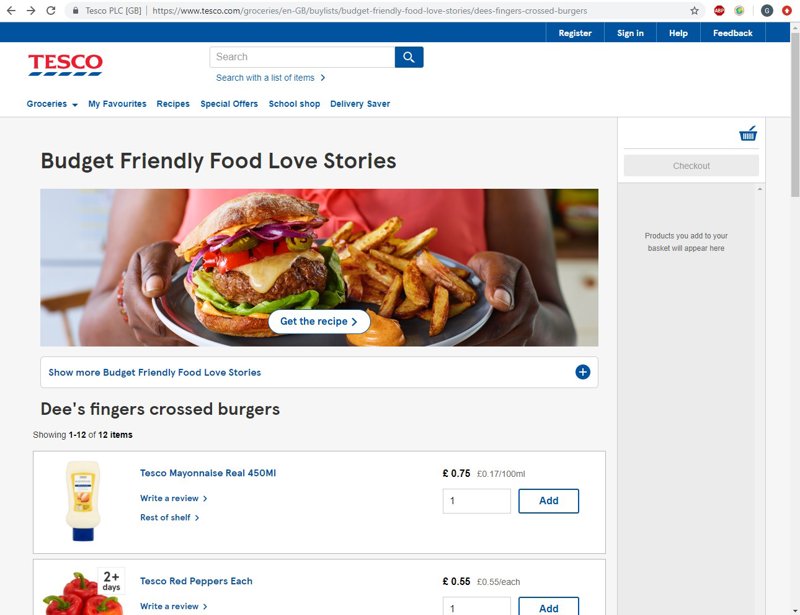
On the recipe page I’m told that this meal would cost £2.87 per serving and earn me 11 Clubcard points. Clicking on a big blue call to action ‘Shop Ingredients’ button an even more useful shopping pop up is displayed where I can add all to basket for £11.49. An even more useful feature is the ability to swap ingredients in the list before adding to basket, just in case you fancied brioche buns instead of white baps.
It is, however, not without its flaws, the recipe called for 4 lettuce leaves so 4 heads of lettuce were automatically added to the basket. A bit overkill if you ask me.
Tesco have created an experience where you can find a new recipe for dinner, buy the ingredients, customise your ingredients and have it delivered to you.
Dinner: from home page to shopping basket in 4 clicks.
Waitrose
Tesco are obviously not the only ones that have thought of this method of shopping. As a fellow market leader, continually highly rated by Which? for their online shopping experience, Waitrose can do it too.
On their groceries home page you’ll find very functional information first, such as how to shop and prompts to view their offers, followed by popular categories. Then seasonal suggestions like barbecue recommendations, sweet summer treats and in season produce. In between OFFERS and a long list of their most popular products I find a recipe for a chocolate wafer cheesecake. Clicking on this recipe card takes me to a list of the ingredients required to make this tempting looking dessert, including the prices and the ability to add to basket individually. Clicking through to the recipe there is a button saying ‘Shop Ingredients’ which takes us back to the previous page.
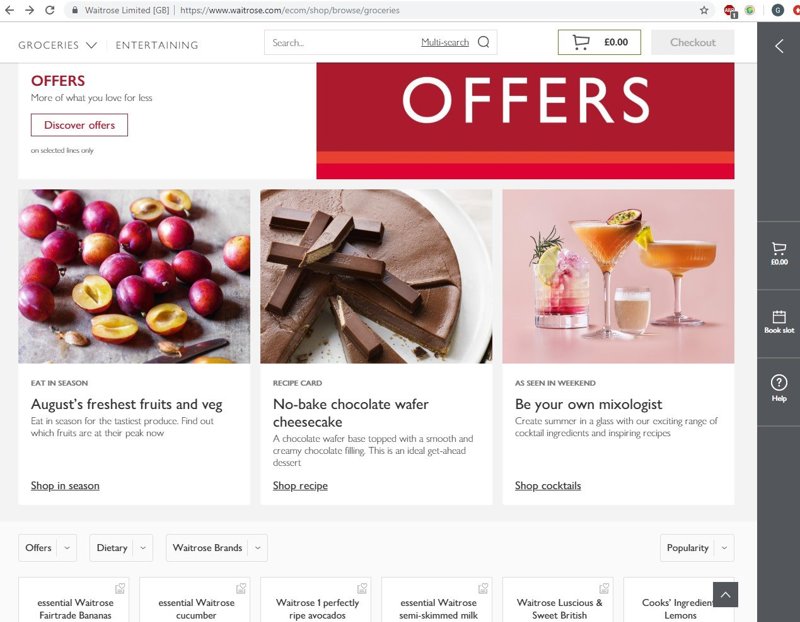
So, dessert comes in at 3 clicks + 9 clicks for each ingredient from home to basket.
However, unlike Tesco, Waitrose have only added the ‘Shop Ingredients’ function on some of their recipes. All the featured recipes and mostly the ones that come up first in their categories. So if you’re using the Waitrose website specifically to find a recipe, that’s really all it is, the recipe. By making it extremely easy to buy, Tesco are more likely to make money off of their back catalogue of recipes.
Waitrose doesn’t offer the kind of detail that Tesco does; the price per serving, price per shopping basket, the ability to customise the basket to your preferred type of bread or cheese for instance. Tesco have perfected the user-friendly nature of the online shop
The two shops appear to be going for different approaches, with Tesco targeting impulse buying and Waitrose’s homepage showcasing offers, highly rated products and in season produce. Waitrose appears to be taking a straightforward approach to food shopping, showcasing low prices and individual products. But if you know what you want already, this could be the best approach.
Customers can go to Tesco for a creative shopping experience; emphasis on experience. The process of shopping in person is becoming more and more experience lead as businesses try to attract people back to the high street, it’s a great idea to create an experience online and cover more bases.
If this sort of customisable user experience is something you wanted to create for your ecommerce site, then get in touch.Click here to find out more and ask us for a consultation.
Share article:

Umbraco vs WordPress: which CMS should you choose in 2026?
Umbraco is more secure by default; WordPress is faster to launch. Which fits your project?
Read more
Local SEO for estate agents: how to improve visibility and win more instructions
Discover how a stronger local SEO strategy can help estate agents improve Google visibility, attract more direct enquiries, and win more instructions.
Read more
Impact of AI on SEO: The 2026 Guide
AI Overviews and answer engines are reshaping search. Here is what the rise of AI means for SEO in 2026, and how to keep your site visible.
Read more
Umbraco vs Contentful: which CMS should you choose in 2026?
Umbraco vs Contentful compared: traditional versus headless, cost, developer experience, and hosting control. A practical guide from 16i to help you choose.
Read more
Umbraco vs Sitecore: Which CMS Should You Choose?
A practical guide to choosing between two leading .NET CMS platforms.
Read more
Umbraco vs Kentico: which CMS should you choose in 2026?
Umbraco vs Kentico compared: cost, built-in marketing tools, e-commerce, and flexibility. A practical guide from 16i to help you choose the right .NET CMS.
Read more
Upgrading to Umbraco 17: a strategic investment for your business
Umbraco 13 support ends December 2026. Umbraco 16 support ended June 2026. If your site hasn't upgraded to Umbraco 17 LTS, here's what's involved and how 16i can help.
Read more
Customer Portal Software vs Bespoke: How to Decide
Off-the-shelf portal software suits simple needs. Bespoke suits complex ones. A practical guide from 16i, with the Grant UK G1 portal as a real example.
Read more